This unknown little tree deserves a page of
it's own. The Coyote willow is widely used in the Western United States to
control rivers banks. They call this Riparian Restoration.
This is what the USDA has to say about this tree.
SILVAR' COYOTE WILLOW Scientific Name: Salix exigua Nutt. spp. exigua
Common Name: Coyote willow
Cultivar Name: 'Silvar'
Selected By: Pullman PMC, USDA-NRCS
Release Cooperators: USDA - Natural Resources
Conservation Service, The University of Idaho-AES,
Washington State University-ARC, Oregon State
University-AES
'Silvar' coyote willow is a deciduous shrub
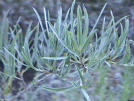 originating from native plants growing along the the Tucannon
River, near Starbuck, Washington at an elevation of 560 feet.
Mature plant height is 22 feet and canopy width is 18 feet at
Pullman, Washington. 'Silvar' is thicket forming, suckering, with
pale blue-green silvery leaves and silvery pubescent twigs. The
leaves are simple, entire, alternate and average four inches
long, 5/16 inches wide, and are persistently hairy. Staminate and
pistillate catkins appear after the first leaves. No disease or
pest of this willow has been noted by the PMC. Willow pollen is
an important food source in the spring for honeybees.
originating from native plants growing along the the Tucannon
River, near Starbuck, Washington at an elevation of 560 feet.
Mature plant height is 22 feet and canopy width is 18 feet at
Pullman, Washington. 'Silvar' is thicket forming, suckering, with
pale blue-green silvery leaves and silvery pubescent twigs. The
leaves are simple, entire, alternate and average four inches
long, 5/16 inches wide, and are persistently hairy. Staminate and
pistillate catkins appear after the first leaves. No disease or
pest of this willow has been noted by the PMC. Willow pollen is
an important food source in the spring for honeybees.
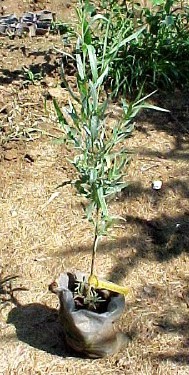
'Silvar' coyote willow grows in moist sands and
gravel, with minor inclusions of sandy loam, and requires a
minimum of 20 to 25 inches annual precipitation. Coyote willow
will establish naturally by seed, however, the more common way is
by hardwood cuttings taken in late winter.
'Silvar' is used in conservation for stream bank
stabilization, riparian site restoration, bioengineering
projects, wildlife habitat, and shelter belts. Other uses are for
erosion control and promotion of native plant diversity.
For additional information contact: Wayne
Crowder, Soil Conservationist or Scott Lambert (PMS),
USDA-Natural Resources Conservation Service, Pullman Plant
Materials Center (509) 335-7376 or e-mail crowder@wsu.edu.